
Need to push water up to 83 bar without burning through your energy budget? Danfoss APP high-pressure pumps reach up to 92% energy efficiency, and more than 24,000 of them are running worldwide. You'll find the full range in our shop, and we're happy to help you pick the right size.
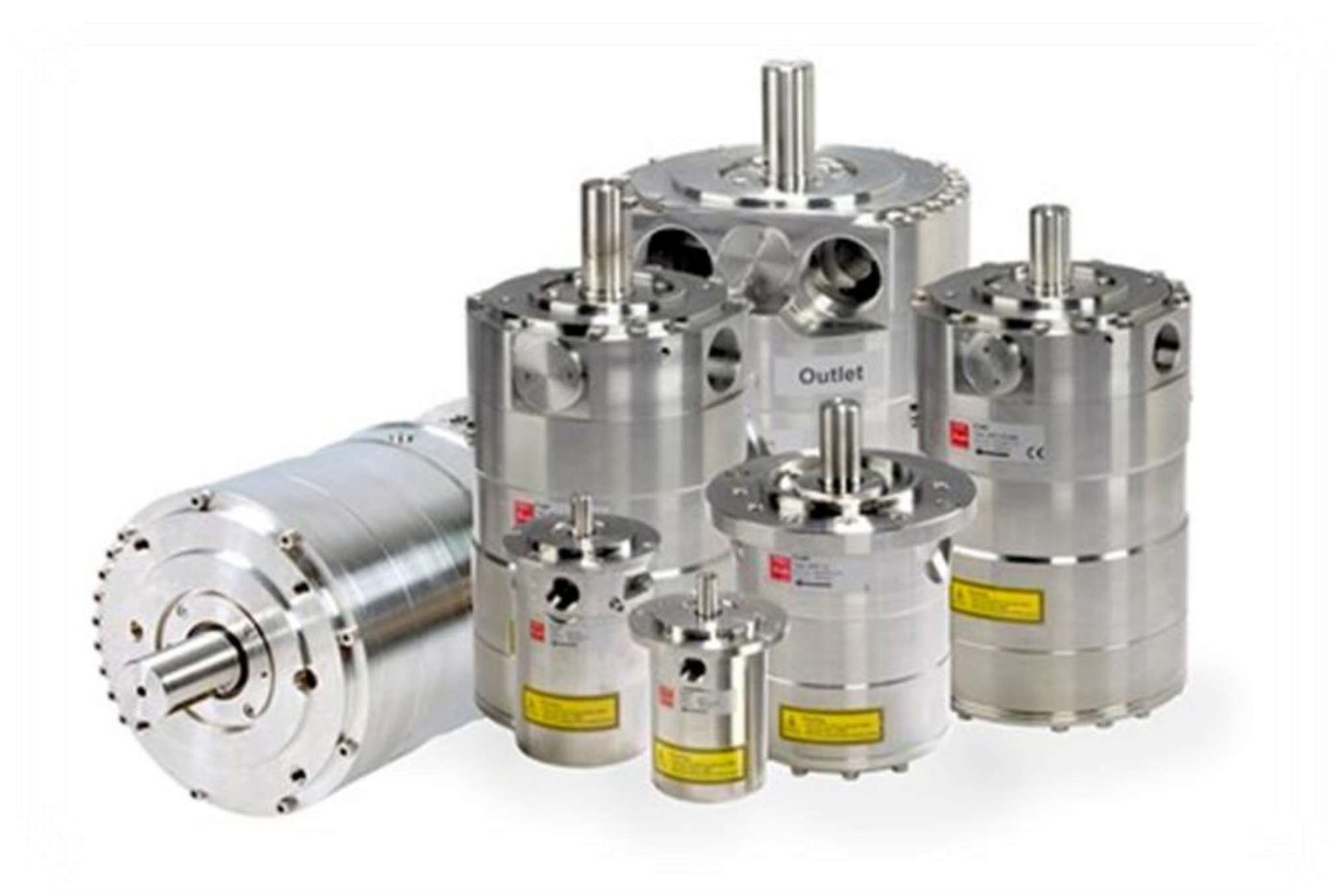
What is a Danfoss APP pump and why does it save energy?
APP (Axial Piston Pump) is a positive displacement axial piston pump. Unlike a centrifugal pump, it delivers the same flow at a given speed regardless of the discharge pressure. You control the flow simply by changing the speed, for example with a Danfoss iC7-Automation drive or a VLT® AutomationDrive FC 301.
Over a typical 20–25 year plant life, electricity makes up more than 95% of total pump ownership cost. Every percentage point of efficiency pays back many times over.
- No oil, no contamination. The pumped water itself lubricates the pump, so there's no risk of lubricant getting into your permeate.
- Service intervals up to 8,000 hours. When Danfoss specifications are met. Simple design with few parts – service can be done on site.
- Built to last. Duplex and Super Duplex stainless steel plus carbon-reinforced PEEK handle seawater, brackish water and wastewater.
- Compact and light. Mount horizontally or vertically, no pulsation dampeners needed thanks to extremely low pressure pulsation.
- Integrated flushing valve. Water flows from inlet to outlet even when the pump is stopped (all models except APP 5.1–10.2).
- Certified. Designed to EN 809, ATEX versions available (marked Ex), produced under ISO 9001, ISO 14001 and IATF 16949.
Browse APP pumps in our shop – from the smallest APP 0.6 up to APP 46.
APP 0.6–46 pumps →Where APP pumps do the work
Their home turf is desalination and reverse osmosis, but they go much further:
Hotels and resorts
Containerized RO units on islands and in coastal regions.
Ships and yachts
Onboard drinking water from seawater.
Offshore
Oil and gas platforms far from shore.
Waterworks
Municipal and regional water treatment.
Mobile systems
Humanitarian and military units in the field.
Industry and ultra-pure water
Production, wastewater (APP W) and humidification.
APP range overview – which size do you need?
An indicative overview based on the Danfoss data sheet. We'll gladly send you exact flow curves and motor power calculations.
| Range | Typical flow* | Max. pressure | Typical use |
|---|---|---|---|
| APP 0.6–1.0 | 0.22–0.54 m³/h | 83 bar | small RO units, yachts |
| APP 1.5–3.5 | 0.53–1.79 m³/h | 83 bar | containerized RO, ships |
| APP (W) 5.1–10.2 | 2.8–8.8 m³/h | 83 bar | RO, wastewater (W version) |
| APP 11–22 | 7.5–21.9 m³/h | 70–83 bar | smaller waterworks, industry |
| APP 21–46 | 14.8–39.4 m³/h | 70–83 bar | medium SWRO, hotels, resorts |
| APP 53–92 | up to 92 m³/h | 83 bar | large desalination plants |
* Indicative, depending on pump size and speed. Looking for ceramic parts? Check out APP 21–38 Ceramic.
Parallel arrays: more pumps, more peace of mind
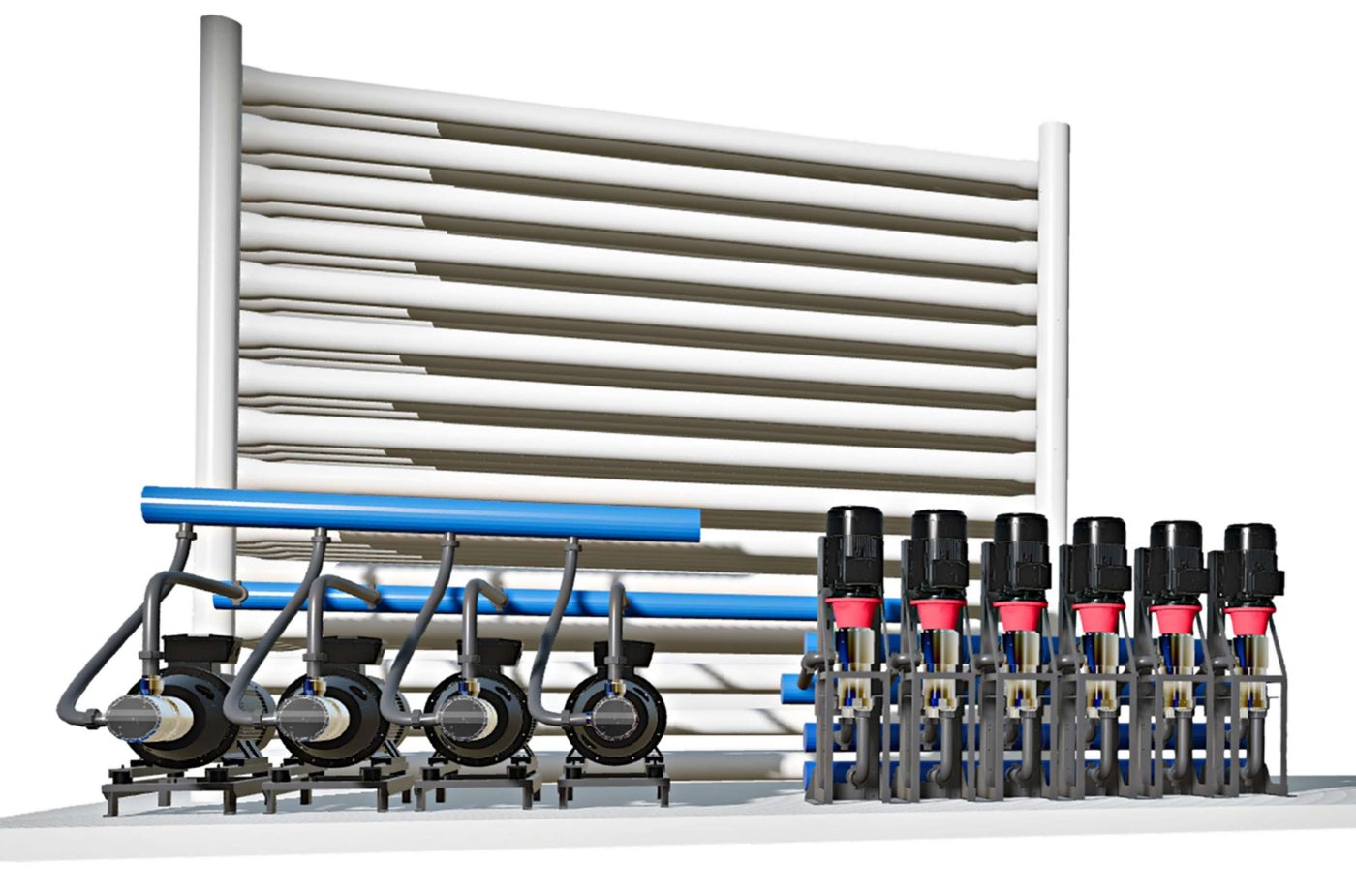
Instead of one large centrifugal pump, you install several smaller APP pumps side by side. A central control system switches them on as demand changes.
- Redundancy: if one pump is offline, the others keep running.
- Scalability: add another pump when capacity needs grow.
- Compact: pumps can even be stacked one above another.
- Low voltage: standard LV motors and frequency converters instead of a costly MV drive.
| Train size (m³/day) | APP pumps in parallel |
|---|---|
| 2,000 | 1 |
| 4,000 | 2 |
| 6,000 | 3 |
| 8,000 | 4 |
What energy-efficient seawater RO looks like
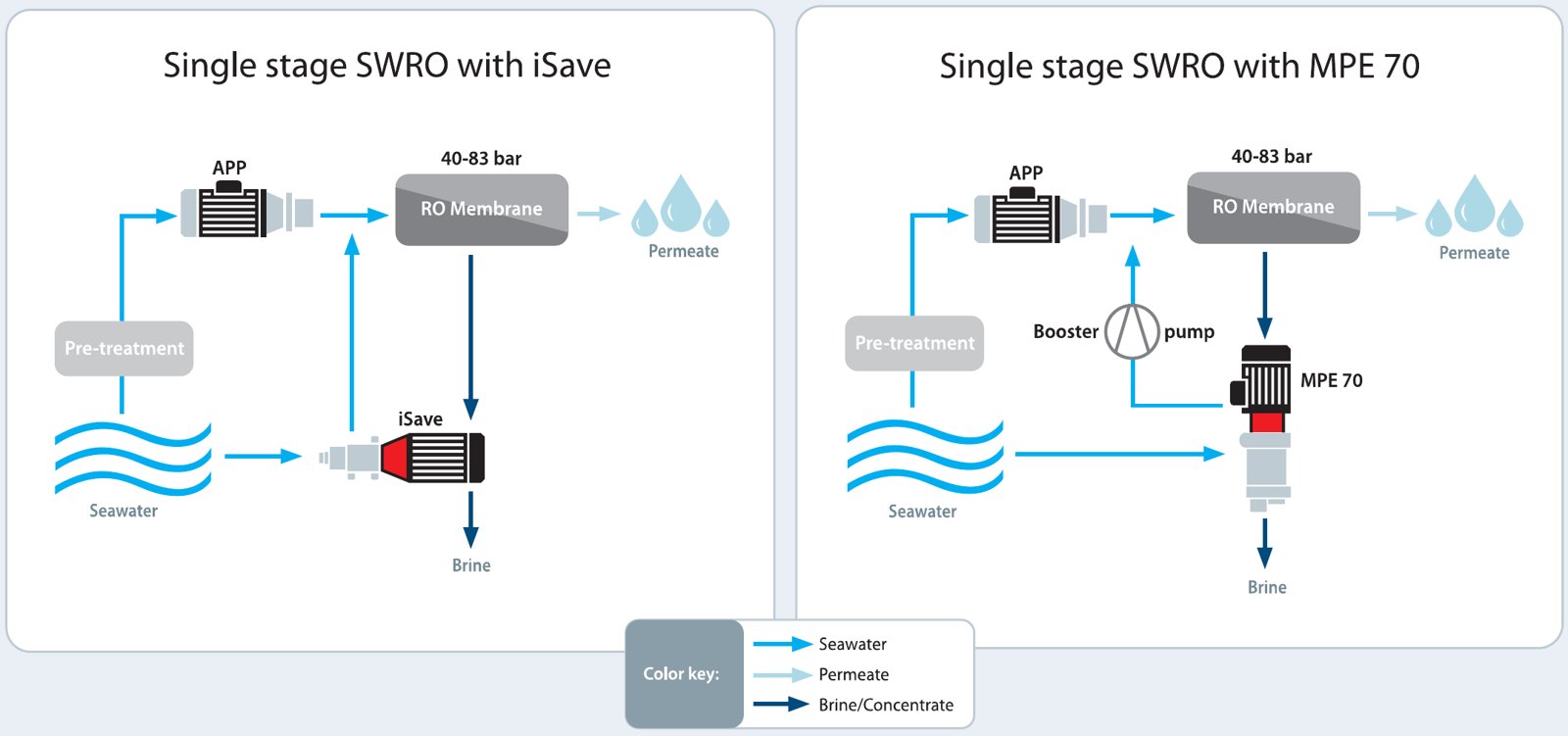 Single-stage SWRO: the APP pump feeds the membrane (40–83 bar), the ERD recovers energy from the brine.
After pre-treatment, the APP pump takes seawater and pressurizes it onto the RO membrane. Out come clean water (permeate) and high-pressure brine. That pressure doesn't have to go to waste. A Danfoss iSave energy recovery device transfers it back into the feed water. It recovers energy with up to 94% efficiency and can cut total SWRO energy use by up to 60%.
Planning a complete RO line? Besides APP pumps, we can also quote iSave and MPE 70 energy recovery devices. Just email info@damatech.eu.
High-pressure humidification and industrial water
High-pressure water mist is quickly replacing traditional humidification in greenhouses, production halls and cold stores. It's reliable and energy-efficient. Danfoss supplies the complete kit:
- PAHT pumps – axial piston technology for ultra-pure and demineralized water. For regular water, there are PAH pumps.
- VDHT solenoid valves – 2/2 and 3/2-way. 3/2-way valves de-pressurize the piping automatically after shut-off.
- VRH relief valves – for safe operation of the whole circuit. Ask for a quote at info@damatech.eu.

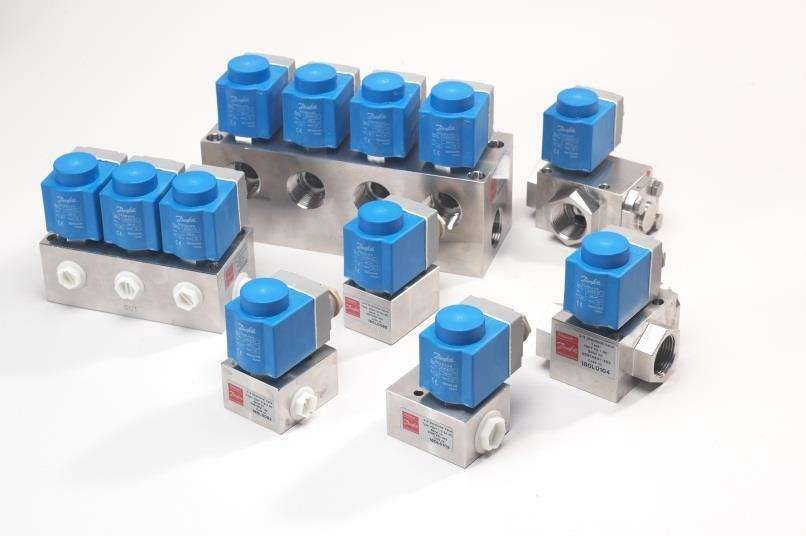
VDHT valves at a glance
- all stainless steel, designed for open systems
- tested for more than 500,000 activations
- PTFE piston sealing, impurities can be flushed from the piston
- dirt tolerant – 200 µm filtration is enough
- media temperature up to 90 °C
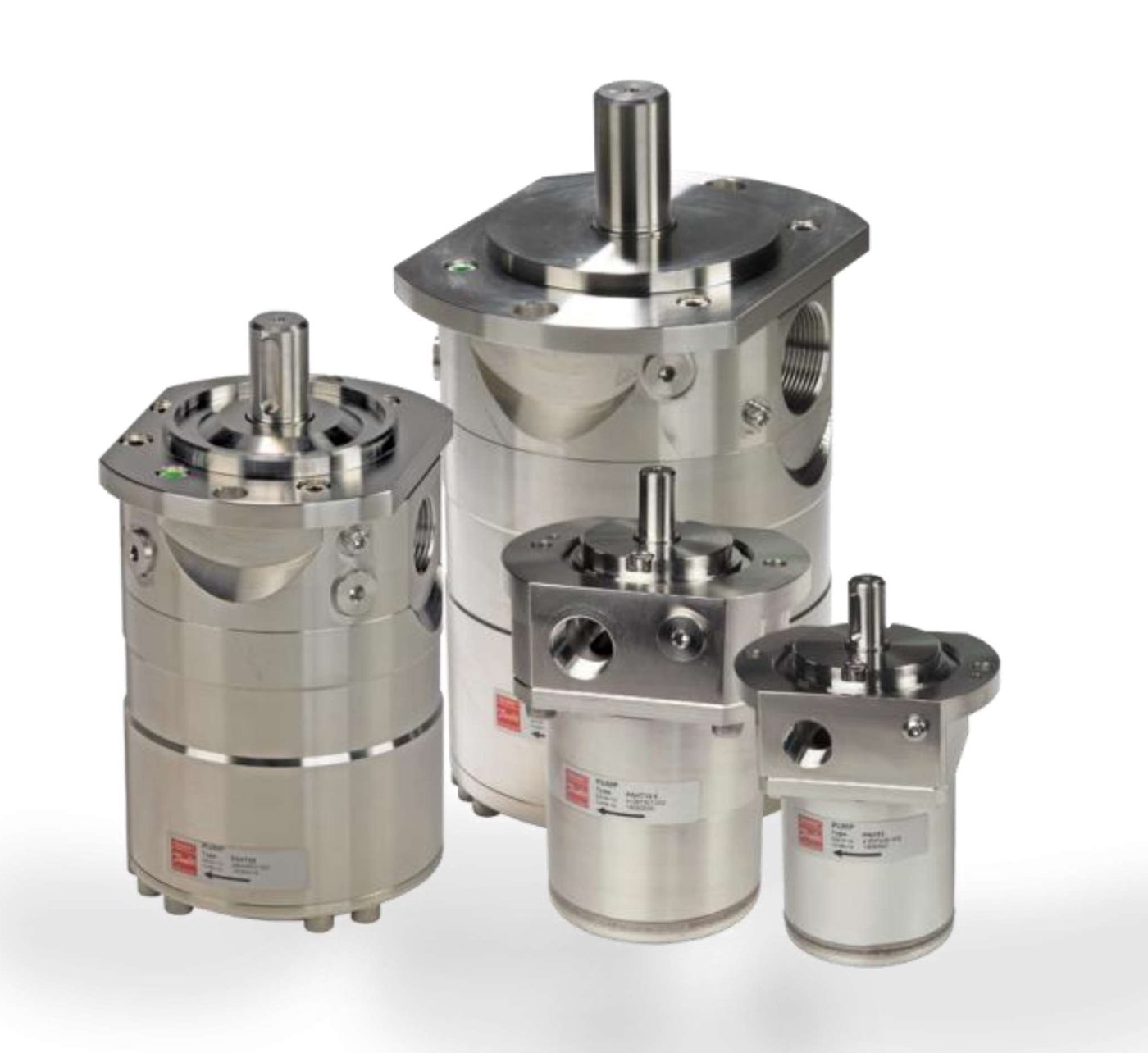 Danfoss PAHT pumps for high-pressure humidification and industrial water.
FAQ
What's the difference between an APP and a centrifugal pump?
APP is a positive displacement pump. At the same speed it keeps the same flow regardless of pressure and stays more efficient, even at part load. A centrifugal pump loses both flow and efficiency as pressure rises.
Does an APP pump need oil?
No. The pumped water does the lubricating, so there are no oil changes and no risk of contaminating the water.
How often does the pump need service?
If you follow the manufacturer's conditions (especially proper inlet filtration), expect a service interval of around 8,000 operating hours. Service can be done on site.
How do I choose the right size?
It comes down to required flow, pressure and motor speed. Send us your RO unit parameters and we'll recommend a specific pump and a matching frequency converter.
Not sure which one to pick? Email info@damatech.eu or call +420 799 040 400.
All high-pressure pumps →Do you install or supply RO systems regularly? Ask us about wholesale cooperation.